Thursday, 2 June 2016

In the ring it is crochet v knitting. But who is the heavyweight?

Crochet v Knitting - who is the heavyweight?

As a relatively new crocheter (almost two years) there are certain facts that have been passed on to me.  One such fact is that crochet uses more yarn than knitting.  Now, I'm not normally one to swim the tide with the other fish - I generally like to make my own mind up about things and I like facts, especially if I have done the work behind my understanding.  For some reason I took the fact that crochet uses more yarn than knitting as gospel.

I can't really trace why it was that I decided to look at the evidence behind this, but it is probably because of my work on The Crochet Circle Podcast that made me want to dig into this topic further.  

So, I thought back to my Standard Grade Chemistry and Physics exams and pondered what the best methodology would be.  

Equipment

Initially I created tensions squares in two different yarn weights and when they were finished and the results were in, I had a look around to see how others had tackled this topic.  There were a few different approaches and some were similar to my methodology.  One of the questions asked was whether there was a difference in lace weight yarns also.  If you have listened to Episode 4 - A Crochet Journey of The Crochet Circle Podcast, you will already understand my new found utter dislike for using small hooks and needles.  But, being a conscientious sort of a person, I also created tension squares in lace weight (grrrrrrrr with a bit more grrrrr on the side!).

Here is what I crocheted and knitted with:   


For each of the above weights I knitted a tension square in stocking stitch and one in garter stitch. For crochet I created squares in double, half treble and treble crochet and cut their tails to the same lengths (2.5cm).

As hard as I tried I couldn't make exact 6" by 6" squares but that was taken into account when I was working through the methodology.


Method

So, I have 15 tension not-squares ready to measure and weigh.  My good kitchen scales can measure down to one tenth of a gram and the dimensions (width and length) of each square were measured to a millimeter.

I plugged all of the weights, widths and lengths into my excel spread sheet and applied the following logic:

  • By multiplying the width and length of each tension square I know what the number of cm2 is.
  • By dividing the weight of each tension square by the overall cm2, I can work out what 1cm squared would weigh.    
  • I can then use the 1cm squared weight to tell me what a 5cm x 5cm (2" x 2") sample area would weigh for each square in each yarn weight.  I used a 5 x 5 area because it is a familiar area for people to relate to because it is used for gauging tension for both knitting and crochet. 
Results

The results are below for each yarn weight:


I also looked at the average (across all three yarns weights) percentage increase of yarn used per 25cm2 for the following:
Treble crochet - 31% more yarn than stocking stitch
Garter stitch - 51% more yarn than stocking stitch
Half treble - 45% more yarn than stocking stitch
Double crochet - 74% more yarn than stocking stitch

Given that treble crochet is consistently the next lightest stitch to use, I applied the same logic as above using treble as the baseline:

Garter stitch - 13% more yarn than treble crochet
Half treble - 10% more yarn than treble crochet
Double crochet - 31% more yarn than treble crochet


Conclusions

It is a gross generalisation to say that knitting uses more yarn than crochet.  If you look at some of the other reviews that I have linked to you will see quotes of three times the amount!

Three results were consistent throughout my study.  Stocking stitch was the lightest, treble crochet was next and double crochet was always the heaviest.  

There is very little in it between garter stitch and half treble which is why the position of those varies across the three yarn weights.  

It the heart of this though, what i am really hoping for is that crochet isn't seen as the heavyweight between the two crafts.  If this also encourages crocheters to look to buy yarn with a higher wool content then even better.  I suspect that some crocheters use acrylic because it has been ingrained in them that crochet uses more yarn and is therefore a more expensive hobby than knitting.  

Anything that encourages the use of renewable materials such as wool rather than synthetic fibres derived from fossil fuels is always going to get the thumbs up from me!


Caveats
1 - The overall weight of each of the squares was used which means that the weight of the cast on/cast off and crochet chain are also included.  If I was going to do this experiment again I would deduct the weight of the initial crochet chains, cast on and cast off so that on the actual stitches were being weighed.

2 - Tension changes from day to day. I created each of the five squares for each yarn weight on the same day over the course of three days (DK, then chunky, then lace weight (grrrr)) to try to ensure that my tension was as even as possible.   I couldn't find a better way around this.


Links to other approaches on crochet v knitting weights:

Here is how the lovely Joanne Scrace at Not So Granny approached it - http://notsogranny.com/2014/07/does-crochet-really-use-more-yarn-than-knitting.html 


I found this Compile Yarn blog that uses a stitch count methodology and creates similar results to my test - http://compileyarn.blogspot.co.uk/2012/03/knitting-vs-crochet-does-crochet-really.html

And I also quite liked this approach which also looks at Tunisian crochet - http://thing4string.blogspot.co.uk/2007/01/unraveling-truth.html 

Wednesday, 4 May 2016

Book Review - Crochet Yeah! by The Crochet Project

As part of The Crochet Circle Podcast, I buy crochet books, undertake projects from them and then write a review.  If you have read my review on Socks Yeah! yarn, you will know that I bought the Crochet Yeah! booklet and that there is a certain amount of crossover between the book and the yarn.  If you haven't read the Socks Yeah! yarn review, you can find it here:  https://www.knitit-hookit-craftit.com/blogs/news/162718215-yarn-review-socks-yeah-from-coop-knits 

If you listen to the podcast then you will know that I will only give a book review if I have undertaken a pattern (or two) from that book.  This allows me to give a more thorough review and give a good, honest opinion on how that book actually performed for a crafter.

The Crochet Project's Joanne Scrace and Kat Goldin teamed up with Rachel Coopey of Coop Knits to create a 6 accessory pattern booklet called Crochet Yeah! using Socks Yeah! as the preferred yarn for each of the patterns.


The booklet (A5 which perfect size to fit in a project bag) has patterns for two hats, a pair of mittens, a cowl and a scarf, ranging from beginner to intermediary:

  • Bromsgrove Hat - Rated easy and uses between 3 and 4 skeins depending on size
  • Evesham Socks - Rated intermediary and uses between 2 and 3 skeins depending on size
  • Tenbury Hat & Mittens - Rated easy and uses 2 skeins
  • Malvern Cowl - Rated beginner and uses 3 skeins  
  • Worcester Scarf - Rated beginner and uses 2 skeins


I started by making the Evesham socks which I crocheted using the Socks Yeah! yarn in shade Iolite (109).  After one sock I then moved onto the Worcester Scarf but made it into a cowl instead because that is a more usable item for me.  For the cowl I wanted to test using a yarn substitute and also wanted to use up some stash yarn, so decided upon Artesano's 4 ply silk in shade Lily Pad.


The booklet is nicely laid out with an introduction to the joint project, moving into a basic stitch guide, information on choosing sizes, tension yarn substitution, finishing and garment after care. These paragraphs are succinct but useful.  

The patterns are well written and three out of the six have charts as well as written instructions.  I am a very visual person, so I find this immensely helpful.  I am wondering whether I inadvertently chose the two patterns I did because they both have charts?  It is very possible.   If find it a quick way to visualise what the stitches are going to create and help commit the row repeats to memory. I really wish more crochet books also provided charts!

As you would expect from the crochet duo, the photography is nicely executed and shows the finished projects off really well, especially as the booklet is in full colour. The model is Joanne and the photographer is Kat, which for me, gives the booklet even more integrity.  

For something like the Evesham sock pattern I would have benefited from a part-way photo at the point where you chain to create the heel flap space.  I would have preferred that to seeing four photos of the finished socks.  That may just be me, I have only been crocheting for a year and three quarters so it may be lack of experience on my part.   

I also like the little diagrams that have been added to the projects so that you can see what direction you should be crocheting in - such as cuff down on the socks.   It may seem simple but from running a knitting and crochet group, I know that some people really struggle to understand where the pattern starts, so the diagrams are a great addition.   

There is a nice mix of stitches used across the six projects with some cross over.  For instance if you were a beginner and started with the Worcester Scarf it wouldn't be a massive step up to try the Evesham Socks if you could already crochet in the round. 

For that reason I think that the booklet provides a great range of different stitches, different projects, all of which are very wearable - something that isn't always the case with crochet books. This isn't a surprise give that Joanne and Kat are at the contemporary end of crochet; the end of the spectrum that I like to loiter around.


The booklet is available for £12 hard copy (plus P&P if you buy online like I did from Coop Knits) or can be downloaded for £10.  I think that this represents good value for money.  I have paid the same amount out for a couple of crochet patterns online (from other designers) and been bitterly disappointed with the instructions once downloaded.  This is certainly not the case with Crochet Yeah! - it is clear, well formatted and a great little resource for the less advanced crocheter or the more advanced crocheter that wants a quick TV crochet project.

I also think that the proof is in the pudding.  My copy of Crochet Yeah! is already battered; it definitely isn't pristine.  There may even be the odd muddy cat paw on it, but that is mainly because my cat sees crochet as a rival for my affection and paws all over it and anything in between him and my hands.   

I will also look out for any further books/pattern releases that The Crochet Project comes up with. If Tin Can Knits are my go-to provider for nice, sizable, contemporary knitting projects, Joanne and Kat under their 'The Crochet Project' umbrella and as individuals are fast becoming my go-to provider for crocheted accessories.


Yarn Review - Socks Yeah! by Rachel Coopey of Coop Knits

As part of The Crochet Circle Podcast I buy, crochet (and knit) with different yarns and then provide feedback on them.  Here's my review of Socks Yeah! from Coop Knits.

I knew this yarn was coming out but it took me a few months to see it in a shop and be able to squish it.  I was actually looking for a contrast yarn to go with some West Yorkshire Spinners 4 ply Mallard (shade 862) for a pair of socks that I was going to knit for my Father-in-Law (size 10 feet = never again!).   The yarn does provide a nice contrast for the WYS's colours but I decided against it and chose the WYS Signature 4 ply cream instead.

Of course, I left the yarn shop with both yarn types - just in case I changed my mind...

So, I stashed the one skein of Iolite (shade 109) that I had bought from Sew - In (Cheadle store).  It stayed stashed for a couple of months until two key things happened:

  • I started The Crochet Circle Podcast (http://thecrochetcircle.podbean.com) with my friend Lynne (http://lynnerowe.weebly.com/).  Part of the podcast is to provide book and yarn reviews.
  • The Crochet Project's Joanne Scrace and Kat Goldin teamed up with Rachel Coopey at Coop Knits to create a 6 accessory pattern booklet called Crochet Yeah! which is based on the Socks Yeah! yarn.  
Having read through the detail of the book I realised that I would need a second skein if I was going to make anything from Crochet Yeah! using the Socks Yeah! yarn.  So, I ordered a second skein in the same shade and a hard copy of the pattern booklet from Coop Knits. 

A mere day later both had arrived and I sat with a coffee pondering which pattern I should choose to go with my dusky blue yarn.  Here is the essential information on the yarn:


I finally decided that I would crochet the most difficult pattern in the book - the Evesham Socks (http://www.ravelry.com/projects/MaDashper/evesham-socks) because it would really help to put the yarn to test as a sock yarn.

Each of the 10 available colours has a very subtle colour blend/marl through it.  The Iolite shade that I chose is predominantly dusky blue but has hues of heather and sage through it too.  I have likened it to the mother-of-pearl effect that you get in shells and it brings a sophisticated colour blend to the yarn that may not be immediately obvious.  Here are the 10 shades available:


Crocheting with Socks Yeah!
The yarn has quite a high twist which makes it perfect for crocheting as this really helps to prevent splitting.  It gives great stitch definition and the nature of the blend also brings great drape to the fabric - but not so much that you don't get structure in the finished piece.

I enjoyed crocheting the first sock, the yarn glides through your fingers and has a really silky (but not slippy) texture.  I was using a standard steel crochet hook and I didn't have any issues with the yarn wanting to fly away. Although the yarn calls for a 2.25mm hook and the pattern calls for a 2.5mm hook, I used a 3mm hook because I am a tight crocheter.   The results can be seen below:


As mentioned, I used the yarn to crochet up a pair of socks for myself.  What I haven't mentioned is that I am fussy and beyond that, I am particularly fussy about things touching my feet. 

Did I mention that I'm fussy?  As much as I really enjoyed crocheting the sock with the yarn I really wasn't convinced that I was going to make the matching one.  I didn't think that the lace pattern would keep my feet warm and I wasn't convinced that the Half Treble Crochet sole was going to be comfortable when I stood up.  I finished the first one, reflected for a moment and then put it on.

I may be fussy but I am also very happy to admit when I am wrong.  I was wrong.  It was about 12.30am and I had forgotten to put socks on earlier in the day so my feet were pretty icy. The yarn is so cosy that the effect was immediate and my feet started to warm up. Luckily the rest of the family was in bed as I walked around the kitchen island repeatedly with one bare foot and one encased in loveliness.

A couple of minutes walking around the kitchen does not a mean that a sock is comfortable though. Fast forward about a week and I had finished the second one so that I could properly road test the yarn and the pattern.  

I have a stand-up desk in my office and on the day that I tested my socks out I spent well over 9 hours standing up in them.  They are comfortable.  They are warm.  The yarn tag says that they are machine washable at 30 degrees on a wool cycle.  All of my delicate items go through the wool wash (it is a 40 degree wash) in my washing machine - including 100% cashmere items so I thought that I should test that socks under the same conditions because I don't want to have to hand wash them.

They were washed, line dried and then finished off on the radiator in the house.  The socks are exactly as they were when they went into the machine - but clean! No shrinking, no stretching, no pilling, just straight back to their original shape.

Knitting with Socks Yeah!
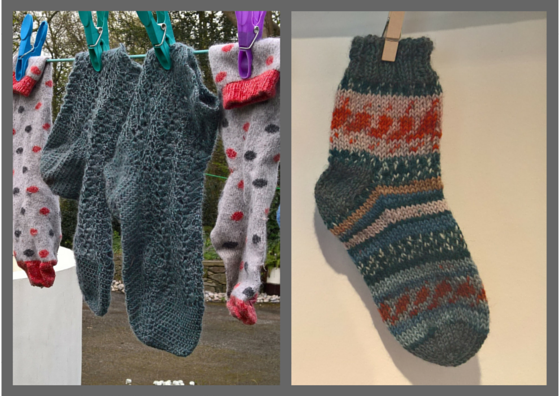
Given that I had a little bit of yarn left (about 20g) I thought I would also test the yarn for sock knitting.  I used the yarn to create contrast cuffs, heels and toes for a pair of socks for my best friend's little four year old boy  (http://www.ravelry.com/projects/MaDashper/basic-socks-2).  The main yarn was Regia Design Lines - Arne & Carlos in the Summer Nights shade.  

WARNING - cute child sock alert!


It is probably unfair to compare the two yarns but they have a similar wool:yarn ratio and pricing point.  In my opinion the Socks Yeah! yarn was much, much nicer to knit with than the Regia.  


In Conclusion
So, the crux of it it that Socks Yeah! is a delight to crochet and knit with and I will definitely buy more and make more crocheted and knitted socks with it.  The drape that the yarn gives would also lend itself to camisoles and shawls. 

If I have one very slight niggle it is that I would like information on the skein ticket and website about where the yarn is grown and spun.  I happened to come across it on a Ravelry thread anyway.  This was the response that Rachel Coopey gave to another inquiring mind:  

"It is south american merino (with a no mulesing guarantee) and it is spun in Peru." 

I wasn't sure what 'mulesing' meant and why you would need a guarantee against it so I looked it up.  You can find details here via Wikipedia: https://en.wikipedia.org/wiki/Mulesing 


As part of The Crochet Circle Podcast, I buy crochet books, undertake projects from them and then write a review.  If you have read my review on Socks Yeah! yarn, you will know that I bought the Crochet Yeah! booklet and that there is a certain amount of crossover between the book and the yarn.  If you haven't read the Socks Yeah! yarn review, you can find it here:  https://www.knitit-hookit-craftit.com/blogs/news/162718215-yarn-review-socks-yeah-from-coop-knits 

If you listen to the podcast then you will know that I will only give a book review if I have undertaken a pattern (or two) from that book.  This allows me to give a more thorough review and give a good, honest opinion on how that book actually performed for a crafter.

The Crochet Project's Joanne Scrace and Kat Goldin teamed up with Rachel Coopey of Coop Knits to create a 6 accessory pattern booklet called Crochet Yeah! using Socks Yeah! as the preferred yarn for each of the patterns.


The booklet has patterns for two hats, a pair of mittens, a cowl and a scarf, ranging from beginner to intermediary:

  • Bromsgrove Hat - Rated easy and uses between 3 and 4 skeins depending on size
  • Evesham Socks - Rated intermediary and uses between 2 and 3 skeins depending on size
  • Tenbury Hat & Mittens - Rated easy and uses 2 skeins
  • Malvern Cowl - Rated beginner and uses 3 skeins  
  • Worcester Scarf - Rated beginner and uses 2 skeins


I started by making the Evesham socks which I crocheted using the Socks Yeah! yarn in shade Iolite (109).  After one sock I then moved onto the Worcester Scarf but made it into a cowl instead because that is a more usable item for me.  For the cowl I wanted to test using a yarn substitute and also wanted to use up some stash yarn, so decided upon Artesano's 4 ply silk in shade Lily Pad.


The book is nicely laid out with an introduction to the joint project, moving into a basic stitch guide, information on choosing sizes, tension yarn substitution, finishing and garment after care.  These paragraphs are succinct but useful.

The patterns are well written and three out of the six have charts as well as written instructions.  I am a very visual person, so I find this immensely helpful.  I am wondering whether I inadvertently chose the two patterns I did because they both have charts?  It is very possible.   If find it a quick way to visualise what the stitches are going to create and help commit the row repeats to memory. I really wish more crochet books also provided charts!

As you would expect from the crochet duo, the photography is nicely executed and shows the finished projects off really well, especially as the booklet is in full colour. The model is Joanne and the photographer is Kat, which for me, gives the booklet even more integrity.  

For something like the Evesham sock pattern I would have benefited from a part-way photo at the point where you chain to create the heel flap space.  I would have preferred that to seeing four photos of the finished socks.  That may just be me, I have only been crocheting for a year and three quarters so it may be lack of experience on my part.   

I also like the little diagrams that have been added to the projects so that you can see what direction you should be crocheting in - such as cuff down on the socks.   It may seem simple but from running a knitting and crochet group, I know that some people really struggle to understand where the pattern starts, so the diagrams are a great addition.   

There is a nice mix of stitches used across the six projects with some cross over.  For instance if you were a beginner and started with the Worcester Scarf it wouldn't be a massive step up to try the Evesham Socks if you could already crochet in the round. 

For that reason I think that the booklet provides a great range of different stitches, different projects, all of which are very wearable - something that isn't always the case with crochet books. This isn't a surprise give that Joanne and Kat are at the contemporary end of crochet; the end of the spectrum that I like to loiter around.


The booklet is available for £12 hard copy (plus P&P if you buy online like I did from Coop Knits) or can be downloaded for £10.  I think that this represents good value for money.  I have paid the same amount out for a couple of crochet patterns online (from other designers) and been bitterly disappointed with the instructions once downloaded.  This is certainly not the case with Crochet Yeah! - it is clear, well formatted and a great little resource for the less advanced crocheter or the more advanced crocheter that wants a quick TV crochet project.

I also think that the proof is in the pudding.  My copy of Crochet Yeah! is already battered; it definitely isn't pristine.  There may even be the odd muddy cat paw on it, but that is mainly because my cat sees crochet as a rival for my affection and paws all over it and anything in between him and my hands.   

I will also look out for any further books/pattern releases that The Crochet Project comes up with. If Tin Can Knits are my go-to provider for nice, sizable, contemporary knitting projects, Joanne and Kat under their 'The Crochet Project' umbrella and as individuals are fast becoming my go-to provider for crocheted accessories.


Tuesday, 3 May 2016

Yarn Review - Regia Design Line by Arne and Carlos


As part of The Crochet Circle Podcast I buy, crochet (and knit) with different yarns and then provide feedback on them.  Here's my review of Regia's - Arne & Carlos Design Line sock yarn.

Back in February 2016, I went to a workshop with Arne and Carlos at Black Sheep Wools in Culcheth, near Warrington.  It is fair to say that they are great fun and have fabulous personalities which really came across during the workshop that we had in the morning and presentation in the afternoon. 

We even managed to squeeze in a quick interview with them for The Crochet Circle Podcast, which you can hear at http://thecrochetcircle.podbean.com/


Add into the mix that I started to learn how to knit socks in January.  So, when I saw that Arne and Carlos had teamed up with Regia to create their Design Line sock yarn, I felt that I really had to give it a go.


I chose the shade Summer Night (03657) (http://us.schachenmayr.com/yarns/regia-4-ply-design-line-arne-carlos)


This is an engineered yarn that is specifically designed for sock knitting.  Given that our podcast is about crochet, I thought I would test it out to see whether it was suitable for crochet projects also.  


I started out by testing double crochet, half treble and treble stitches and quickly came to the conclusion that the colour pooling wasn't great and needed to find a different stitch.  I then saw a friend's tweed/linen stitch crochet project and thought it would be perfect for the yarn (you can see the outcome of all of these stitches to the left and the Tweed/Linen stitch is at the top of the sample).


Having photographed the initial stitch sample, I unraveled the yarn and decided to see how it would fare as a crocheted sock.  Given that I wanted a 50g ball to go quite far, I opted for a pair of baby booties/socks (6-9 months for my friend's baby 'The Duke') and a pair of knitted socks to fit her other four year old son, 'Winkie'.  I still had a little yarn left over, even though I had pattern matched both pairs and therefore created a little wastage.


The baby booties were crocheted up using a 4mm hook and the yarn only split a little which may have been exacerbated by my having already crocheted the yarn once and then unraveled and rewound it.  The yarn wasn't prone to splitting the first time around.  This link will take you to my Ravelry project page for the booties:  http://www.ravelry.com/projects/MaDashper/crocheted-baby-socks


 Given that the yarn has really been created for sock knitting, I thought I should do that too.  You can see my results by going to the following Ravelry project page:  http://www.ravelry.com/projects/MaDashper/basic-socks-2   Again, there were no real issues in using this yarn, it only split a little but probably wouldn't of had I not already used it once.  I knitted the socks with 2.5mm DPNs and there was just the right amount of stickiness between the yarn and the Symfonie needles.      


There was no discernible difference in the feel of the yarn, whether crocheting or knitting with it. What I would say is that is that there is a slight amount of crunch with it which means that it isn't as soft a other yarns (like Socks Yeah!).  You can almost feel a starchiness within the yarn as it runs through your fingers which is okay but not ideal for me.

Where this yarn wins out is that the engineered pattern is absolutely fabulous and I have been asked time and time again whether it is Fair Isle.  I really do wish I was that good at Fair Isle! 


I guess that the big question is - will I ever use this yarn again?

Yes - I would knit a pair of socks for somebody else using this yarn (somebody less fussy than I am about what is on my feet).
Possibly - I would use the yarn to crochet a project using tweed/linen stitch.
No - I wouldn't use the yarn to crochet more socks/booties, but I wouldn't do this with any patterned yarn having done this yarn review.

It is worth conducting a search on Ravelry for crocheted projects using this yarn.  There are some other socks and I suspect that the yarn looks better crocheted for bigger socks.  It still isn't for me, but may be right up someone else's street.  


The couple of small niggles that I have are that:
  1. The yarn is 75% wool but is a bit lacking in softness.
  2. I suppose that the wool used is a blend - nothing the matter with that, but I would like more detail.  A blend of what?
  3. There is no information on the ball band about where the yarn is manufactured.  I think this is essential information in this day and age. 

On the upside:
  1. The patterning when knitted looks amazing.
  2. For engineered sock yarn this is in a comparable price range with others.
  3. The combination of colours (across the range) is very well thought out and complimentary.
  4. Regia yarns come with a 10 year guarantee, with faulty yarns being replaced.


Wednesday, 27 April 2016

When setting up web domains and email forwarding packages...

It’s always a good idea not to have all your eggs in one basket and to keep your options open. In theory it allows you to be flexible and agile in your decision-making later on.

That’s why, when I knew that the business name was going to be KNIT IT – HOOK IT – CRAFT IT, I bought the website domain names www.knitit-hookit-craftit.com and www.knitit-hookit-craftit.co.uk from Fasthosts.co.uk; a company I have used previously, one with a very detailed but user friendly dashboard, and one that also does website hosting, email forwarding and so forth should I require it.

I wasn’t sure whether I was going to host my website with Fasthosts or not but I knew I was going to need emails at the very least so, taking a ‘belt and braces’ approach I checked the box for a hosting package whilst I was registering the domain names – specifically I linked the hosting package to my .com URL.

This meant that, even before setting up the website I had email forwarding from the .com domain name so, by simply adding the relevant POP3 and SMTP settings in my Outlook on my laptop, anyone emailing fay@knitit-hookit-craftit.com would pop up in my inbox.

Ultimately, after much research about secure payment gateways and other things that make for a good and secure customer experience when shopping websites, I elected to host my site through Shopify – a Canadian based company that provide a sold eCommerce platform for start-ups and SMEs.

I mentioned that Fasthosts have a detailed dashboard that allows for simple control over DNS records?

Well, going into that dashboard and changing the DNS to create the relevant A Record and CNAME settings was a piece of cake. And it worked straight away… for the .co.uk domain name.

That was where the trouble started.

In my relative ignorance, by attaching the hosting package to the .com domain name in Fasthosts, I had effectively ‘hard-wired’ certain DNS settings.  Simple solution - remove the hosting package. The only trouble with that is, when I did so, I inevitably disabled my email forwarding… which meant I could not get emails any more.

So, I removed the web-hosting package in Fasthosts and replaced it with an email forwarding only package. That got my emails working again but as far as pointing the www. at my Shopify shop was concerned it didn’t do me any good at all… and after another frustrating week of to and fro on the ‘live chat’ support services with both Shopify and Fasthosts (both very good and very patient, by the way) I discovered that there was still a hidden alias for the www. lurking around in the DNS settings.

It all got to be a bit of a pain in the neck and all the time the clock was ticking; all of my marketing materials related to the .com domain name so, although the .co.uk domain was up and running, it wasn’t what I wanted to promote.

Having finally identified that the rogue www. alias was located in the email-forwarding package in Fasthosts, I elected to move my email forwarding to Zoho.com (a free entry-level package and a straightforward transfer process for my mail boxes; changing the POP3 and SMTP settings in my Outlook was also necessary). Then I switched off the email-forwarding package in Fasthosts. This meant also switching off Fasthosts ‘automatic updates’ to the DNS settings (they kept defaulting back to the package that was attached to the domain name, which is where the alias for the www. kept creeping back in), which felt like a scary thing to do because normally automatic updates are there to stop relative novices like me from breaking things.

It worked.

The domain name started pointing at the right IP address and Shopify’s dashboard started to tell me that an SSL certificate had been requested for the .com domain. Then, this morning, the SSL certificate was confirmed and .com finally started pointing at the right place.  This has taken almost a month to achieve.

Neither Fasthosts, nor Shopify did anything wrong here – it was a bad decision by me at the early part of this process. I should have followed my own advice more rigorously.

The lesson to take away from all this is actually that I was right in the first place - it’s always a good idea not to have all your eggs in one basket and to keep your options open. It allows you to be flexible and agile in your decision-making later on.

The problem was I kept some eggs together in the same basket – I had  enabled an element of hosting with the company that I registered the domain with.

If I had only registered my domain names with Fasthosts, and had my email forwarding elsewhere (a service like Zoho.com) from minute one then I would never have had any problems whatsoever, and I would have had sufficient flexibility to make effective agile operational decisions when I needed to, and to have them work straight away.


Anyway, lessons learned…

Here is the new website:  www.knitit-hookit-craftit.com


Friday, 1 April 2016

Why would you launch your new business and podcast on the same day?

If you asked me whether I was a completer/finisher I would say that I was.  That is all well and good until I remember that I am also two other things:

1 - a bit of a perfectionist
2 - a procrastinator

The two things don't really go hand in hand.  I procrastinate because I like (possibly need) the pressure of a deadline to really spur me into doing the things that I have to do instead of the things that I want to do.  I may write another blog about frog swallowing in the future...

I am a perfectionist because, well, that is what I am.  Don't get me wrong, I understand the 80:20 rule and apply it most of the time, but not always and not always at the best time.

Here is an example of why I shouldn't leave things until the last minute just to build pressure so that I get the job done.

If you have read my earlier blogs then you will realise that I have my own start-up company and have done since the beginning of January 2016.  For a few very good reasons, it has taken longer than imagined to get the right stock through the door (a lot of the manufactured items are being controlled by me and are British wherever possible, which takes more time than simply buying wholesale from another supplier), entered onto a website and up for sale.

Initially I had hoped to have a website up and running by the very beginning of March.  Already I am a month behind but have held off because I wanted to have a decent level of stock when I launch and I have decided in my infinite wisdom to combine two deadlines and launch KNIT IT - HOOK IT - CRAFT IT at the same time as my new podcast - The Crochet Circle.  Yes, I do like a pressure deadlines, don't I?  Both need to be launched today...

It is currently 11.04 am and I have had just under two hours sleep because of software issues in loading up the podcast.  As it stands we (I do the podcast with my friend Lynne Rowe http://thewoolnest.blogspot.co.uk/ ) have got passable show notes up for two episodes of The Crochet Circle podcast and Episode Two is up (http://thecrochetcircle.podbean.com/).  Tricksy little Episode One decided to play silly buggers and so I need to do more work on it, load it up and get it out today so that we can start the social media machine and get the podcast properly 'out there'.


Therefore, it is highly unlikely that my website for KNIT IT - HOOK IT - CRAFT IT (KIHICI) will be up until later tonight (possibly after I have had some sleep).  Normally I would see this as a total failure to deliver a deadline.  However, nobody really knows about KIHICI yet and given that I partly control the podcast website pages, I can just turn off the ones that mention KIHICI until I am ready.

So, the perfectionist is saying "get the podcast out and make sure it is good and take your time today to set KIHICI up" and be really happy with the initial content that I am pushing out to the World.

Soooo, it is now 15.51 and we have two live episodes and Lynne is just about to finish off the last couple of changes on the show notes.  It all looks really good.  Given that until 5 weeks ago we had never recorded a podcast, edited in Audacity or created show notes, I am really proud of what we have achieved in such a short space of time.  In a year I may look back at the first few episodes and think that I could have done a better job - that'll be the perfectionist in me.

As for the Fay the procrastinator?  Well I appear to be writing a blog entry rather than letting the rest of the World have the potential to look at my new baby - KNIT IT - HOOK IT - CRAFT IT.

Will I be pressing 'publish' on my website at midnight tonight?  Probably.